
Budeiri Library Jerusalem: Manuscripts, Family and History

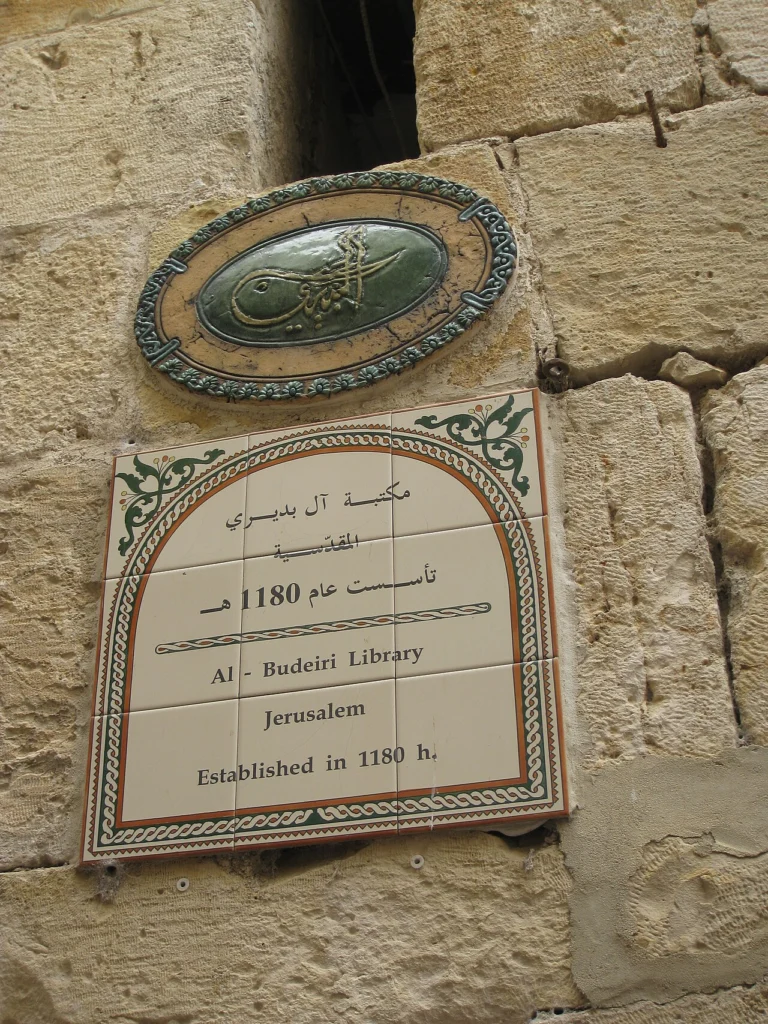
The Budeiri Library is a private family library in the Old City of Jerusalem, known for its collection of Arabic manuscripts built up by the Budeiri family. Researchers use it mainly for the manuscript holdings and for the history recorded in colophons, ownership notes and catalogues.
What is the Budeiri Library?
The Budeiri Library, also called the Al-Budeiri Library, is a private family library and archive in the Old City of Jerusalem. Its holdings centre on some 900 Arabic manuscripts, together with printed books and family papers. The collection takes its name from the Budeiri family, a Jerusalemite family whose members assembled and kept the manuscripts over several generations. The library operates from the former home of Sheikh Mohammad Ibn Budeir, and access is normally by appointment rather than as a walk-in museum.
History of the Budeiri Library
The collection began as the personal library of Sheikh Mohammad Ibn Budeir Ibn Mohammad Ibn Mahmud Ibn Hubaysh, also known as Sheikh Budeir (1747–1805). According to the Palestinian American Research Center, he began collecting manuscripts at the age of 15 and continued until his death in 1805. For a long period before 2003 the library was closed and neglected; family members funded a renovation and reopened it in 2003. Since then the library has acquired and repaired a further 520 manuscripts, largely from members of the extended Budeiri family. A catalogue of the manuscript holdings was published in 1987, and a new draft catalogue was completed in January 2011.
What manuscripts does the Budeiri Library hold?
The manuscript collection includes some 900 items dating from as early as the 12th century CE, together with dozens of printed books from the 20th century and family documents such as diaries, personal correspondence and legal papers from the late Ottoman period.
Most of the manuscripts are written in Arabic; a few are in Ottoman Turkish or Persian. The items are codices, or bound manuscript books, and scholars read the colophon—the copyist's note usually at the end—for names, dates and places. The subjects lean towards Islamic religion, Qur'anic sciences and Sufism. Six of the manuscripts are described as unique, with no other known copies, and eighteen were copied by Sheikh Mohammad Ibn Budeir himself. The oldest recorded item, "The Qasheiri Message", was composed in 1167 CE according to descriptions published by the Manumed Project.
Condition varies. According to the Palestinian American Research Center, roughly half of the manuscripts are well preserved, about a quarter need rebinding, and the remainder are wholly or partly damaged.
Where to consult catalogues and records
Different institutions describe portions of the collection in different ways.
| Source | What it offers |
|---|---|
| Hill Museum & Manuscript Library (HMML) | digitised images and descriptive records for the Al-Budeiri collection; images need a free Reading Room account, descriptions do not |
| National Library of Israel | standardised bibliographic records for manuscript collections of Jerusalem family libraries |
| Al-Furqan Islamic Heritage Foundation | the World Survey of Islamic Manuscripts (1994), with figures for surveyed Islamic manuscript collections |
| Librarians and Archivists with Palestine | profiles of libraries and archives for researchers working in Palestine |
Digitisation and access
Since late 2008 the collection has undergone preservation and digitisation under the Manumed Project, a collaboration between the EU-funded Euromed Heritage IV programme and the Arab Studies Society. About 900 manuscripts were digitised, and the images are available through the Hill Museum & Manuscript Library. Physical access to the library remains limited and is usually by appointment or research request.
Notes on Mediterranean manuscript collections are published by manumed.org; see About manumed.org, contact the editorial desk with corrections, and read the privacy policy for how this site handles visitor data.
FAQ
Where is the Budeiri Library?
It is in the Old City of Jerusalem, as a private family library, not a general public museum.
Who founded the Budeiri Library?
The Budeiri family collected and kept the manuscripts over several generations.
Can the public visit the Budeiri Library?
Access is limited and usually by appointment or research request; it is not a walk-in museum.
Are the Budeiri Library manuscripts digitised?
Some are described or digitised through institutional projects such as HMML; others remain available only in situ or through catalogues.
How many manuscripts does the Budeiri Library hold?
Sources report different totals, so the article gives a range with source and year rather than one number.
Sources
Hill Museum & Manuscript Library (HMML); National Library of Israel; Al-Furqan Islamic Heritage Foundation; Palestinian American Research Center; Wikipedia article on the Al-Budeiri Library; Librarians and Archivists with Palestine.
Keep reading