
Library of Alexandria Manuscripts: What Survives Today?

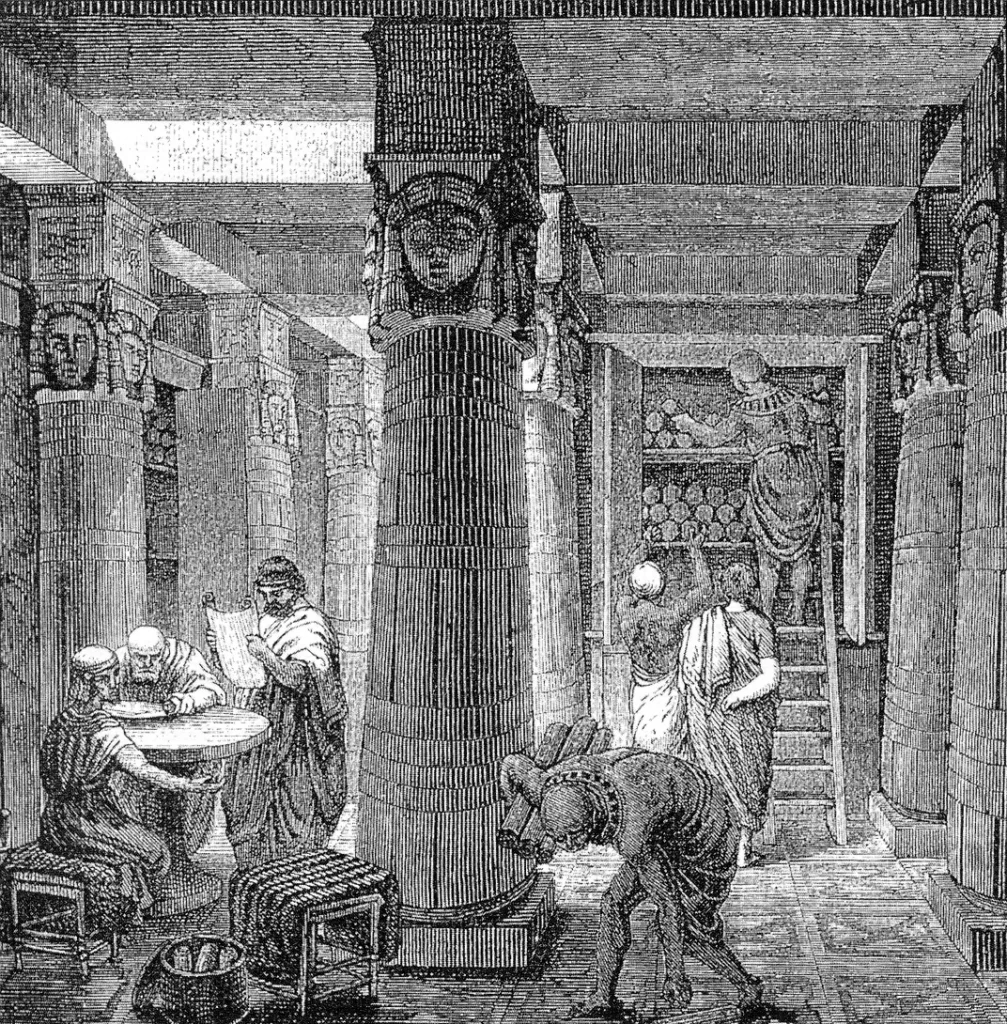
O. Von Corven, Public domain, Wikimedia Commons
The ancient Library of Alexandria survives mainly as fragments and indirect quotations, not as a standing manuscript collection. The modern Bibliotheca Alexandrina, opened in 2002, is a separate institution. Its manuscript museum and rare books section hold Arabic, Greek and other Mediterranean material. The rare books collection reports more than 15,000 items from 1496 onward.
- What was the ancient Library of Alexandria, and what did its manuscripts look like?
- Ancient library vs modern Bibliotheca Alexandrina: at a glance
- What does the modern Bibliotheca Alexandrina hold?
- Where are the Greek and Coptic manuscripts of Alexandria today?
- Did any ancient Library of Alexandria manuscripts survive?
- How to check a manuscript's provenance and consult the original record
- Frequently asked questions
- Sources
What was the ancient Library of Alexandria, and what did its manuscripts look like?
The ancient Library of Alexandria was founded in the third century BCE under the Ptolemaic dynasty. For context on the library's scale and later reputation, see the Library of Alexandria overview by Duke University Libraries. Its holdings were principally papyrus rolls, not bound books. The codex — a book made of folded leaves — became common only centuries later.
Ancient sources give widely different totals, with estimates ranging from about 40,000 to 700,000 rolls. No continuous collection survives from that period, and later tradition often conflates different phases of the institution. Scholars therefore describe the ancient library through indirect evidence: quotations, papyrus fragments and later catalogues, not through an intact archive.
The library's fame rests on scale and ambition rather than on any surviving shelf list. Manuscripts associated with Alexandria today belong to later periods and different institutions. That is why any modern guide must separate the ancient library from the present-day Bibliotheca Alexandrina.
Ancient library vs modern Bibliotheca Alexandrina: at a glance
The two institutions are often merged in search results, but they differ in date, format and survival.
| Feature | Ancient Library of Alexandria | Modern Bibliotheca Alexandrina |
|---|---|---|
| Institution | Royal library founded in the third century BCE under the Ptolemaic dynasty | Public research library inaugurated in 2002 in Alexandria, Egypt |
| Support | Papyrus scrolls; the codex became common only later | Printed books, manuscripts, digital collections and special collections |
| Status | No continuous collection survives; known through quotations, fragments and later copies | Active library and cultural centre with reading rooms and a manuscript museum |
| Consultation | No original archive to consult; scholars work from papyri and later manuscript copies | Open to researchers and visitors; holds a Rare Books Section and a Manuscript Museum |
What does the modern Bibliotheca Alexandrina hold?
According to the Bibliotheca Alexandrina, the modern institution maintains several departments relevant to manuscripts and rare books.
- Manuscript Museum: Arabic and other Mediterranean manuscript traditions on display.
- Rare Books Section: more than 15,000 rare books, with the earliest item dated to 1496.
- General collections: printed books, periodicals and digital resources.
The Manuscript Museum does not publish a single total for its holdings in the institutional overview. The Rare Books Section is the clearest countable collection: more than 15,000 rare books, the earliest from 1496. These are printed books rather than manuscripts, but they sit alongside the manuscript holdings and are often what visitors encounter first.
A rare book, in library terms, is an item whose age, scarcity or provenance places it in a special collection. The 1496 date marks the start of printed books in this collection, not the age of the ancient library. The modern Bibliotheca Alexandrina was built near the site of the ancient library. It is a new institution; it does not claim to house the ancient library's own manuscripts. Its Arabic manuscript holdings are usually catalogued by script and tradition, including Naskh and Maghribi styles. A finding aid or catalogue record will usually identify the script, which helps researchers locate an item.
Researchers should therefore treat the 15,000 rare books figure as a department total, not as the size of the whole manuscript museum. The institutional overview does not give comparable figures for every department.
Where are the Greek and Coptic manuscripts of Alexandria today?
Some of the most substantial Greek manuscript holdings are in the Patriarchal Library of the Greek Orthodox Patriarchate of Alexandria. That library reports more than 500 Greek manuscripts. These belong to the later Christian history of Alexandria, not to the ancient Ptolemaic library.
Coptic manuscripts are spread across institutional collections, but no single, citable total for Alexandrian Coptic holdings appears in the sources reviewed for this article. Researchers usually locate them through library catalogues and published finding aids rather than through one Alexandrian repository.
The distinction matters because the ancient library was not a Christian or Islamic institution. The manuscript collections now associated with Alexandria reflect different communities and periods. A Greek liturgical manuscript in the Patriarchal Library is a product of Byzantine and later tradition. An Arabic manuscript in the Bibliotheca Alexandrina belongs to the Islamic and modern history of the city. For Coptic material, major collections exist in Egypt, Europe and North America, but they are usually described by holding institution. Provenance research, not geography alone, is what connects a manuscript to Alexandria.
Did any ancient Library of Alexandria manuscripts survive?
Almost nothing from the ancient library survives as a continuous collection. What remains is indirect: papyrus fragments, quotations in later authors and manuscript copies made centuries afterwards. Scholars therefore speak of the transmission of texts rather than the survival of the library's own manuscripts.
A single fire is a common explanation, but the ancient sources describe several episodes of damage and decline across centuries. Modern historians treat the end of the library as a process rather than one event. Some Homeric and philosophical texts were copied so widely that they survived through medieval manuscripts. Those later copies do not mean the volumes sat on the ancient library's shelves. They are later witnesses to texts that may once have been there.
Papyrus finds from Egypt sometimes preserve lines of literature that ancient authors attributed to Alexandria. Their exact link to the library is rarely certain. In short, the library's manuscripts survive as cultural memory and textual tradition, not as an archive that can be consulted.
How to check a manuscript's provenance and consult the original record
Provenance means the history of ownership and custody of a manuscript. Checking it usually begins with the catalogue record, not the object itself. A colophon, a finding aid and a catalogue each serve a different purpose, but together they let a researcher trace an item from shelf to source.
- Read the colophon. A colophon is a note, usually at the end of a manuscript, that may record the copyist, the date and sometimes the place of copying.
- Examine the physical description. Codicology, the study of how manuscripts are made and bound, and palaeography, the study of handwriting, help date and localise an item.
- Use a finding aid. A finding aid is a structured guide to a collection that lists its contents and administrative history.
- Consult the holding library's catalogue or contact the reading room. If no online catalogue exists, write to the repository that holds the item.
Some libraries publish digital facsimiles, but the descriptive record is what lets a researcher find and cite the item. For how this site approaches sources and corrections, see the editorial policy and sources; to get help with a specific enquiry, contact the editorial desk. Our privacy policy explains how we handle correspondence.
Frequently asked questions
Did the Romans own the Library of Alexandria?
No. The library was founded under the Ptolemaic dynasty in the third century BCE and later operated during the Roman period, but it was never Roman state property. Roman rule did not make the library a Roman possession; it functioned under different administrations.
What is the oldest library in the world?
There is no consensus. Archives and institutional collections existed before Alexandria, but the city's library is usually cited for its fame and scale, not for verifiable antiquity. Alexandria's fame comes from its scale and later reputation, not from being the first library.
Did the Library of Alexandria have books?
Yes, but mostly papyrus scrolls rather than bound codices. The word \"book\" can mislead if it suggests a modern codex; the ancient library's holdings were rolls. A scroll is a roll of papyrus; a codex is a book with folded leaves, a format that arrived later.
Did anything survive the burning of the Library of Alexandria?
Very little in situ. Most texts survive through quotations, papyrus fragments and later copies, not as a continuous collection from the ancient building. No single fire destroyed the whole collection; decline happened over centuries.
Sources
- Bibliotheca Alexandrina — institutional homepage and collection overview.
- Duke University Libraries — blog overview of the Library of Alexandria.
- Greek Orthodox Patriarchate of Alexandria — Patriarchal Library holdings figure cited in the text.
Keep reading